
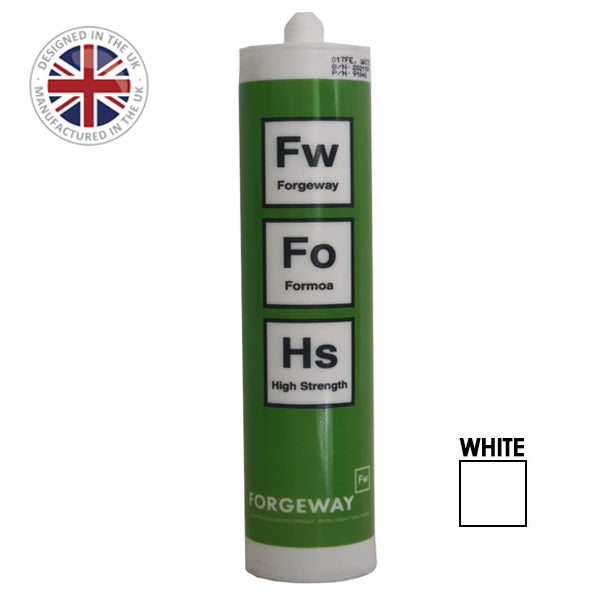
The short answer: there isn't one best glue for stainless steel, and Forgeway, who make the adhesives we sell, say so plainly. For stainless joints that see movement, vibration or weather, such as panels on vehicles, we'd use a flexible MS polymer like Formoa 017FE. For a rigid joint that needs very high strength, an epoxy or a Purok or Aerok MMA adhesive is the better choice. Whichever you pick, the surface preparation decides most of the result, especially on polished stainless.
This post is for fabricators, vehicle builders and anyone bonding stainless steel to itself. It's based on Forgeway's guide to bonding stainless steel to stainless steel, with our own notes on products and prices.

Is stainless steel easy to glue?
Standard stainless usually is. A light abrasion of the bond area is normally enough to give the adhesive something to key into.
Highly polished stainless is harder. The smoother the surface, the less there is for the adhesive to grip. Forgeway suggests grit blasting, sanding or laser treatment, but stainless is a hard metal, so abrading it takes real effort. If the polished look matters, keep the preparation to the areas that will be hidden under the bond.
Grade matters too. Some stainless grades with extra chromium can affect adhesion and may need a primer or adhesion promoter. Don't assume every sheet behaves the same: test the grade you're actually using.
Which types of adhesive work on stainless steel?
Stainless joints usually need a structural adhesive. Forgeway also mentions MS polymer (hybrid) adhesives as a semi-structural option that bonds and seals in one bead. Here's how the main families compare, using Forgeway's typical figures for metal bonding:
| Adhesive | Typical strength (up to) | Flexibility | Watch out for |
|---|---|---|---|
| Epoxy | 30 MPa | Brittle unless impact-modified | Slow cure, needs full prep, mixing errors with two-part packs |
| MMA (acrylic), e.g. Purok or Aerok | 25 MPa | Brittle unless impact-modified | Strong odour, flammable, fast cure leaves little positioning time |
| Polyurethane | 20 MPa | Highly flexible | Contains diisocyanates, which are restricted and need user training in the UK and EU |
| MS polymer, e.g. Formoa 017FE | 5 MPa | The most flexible | Lower strength, thick to gun, slow full cure |
Forgeway makes a point worth repeating: on joints that move, flexibility matters as much as strength. A very strong but brittle bond can still fail if the joint flexes.
When would we use Formoa 017FE on stainless?
When the stainless is on something that moves. Forgeway's own examples for 017FE include bonding stainless steel side panels onto buses, where the joint takes vibration, temperature swings and weather for years. That's the sort of job it suits:
- Flexible strength. 4 MPa tensile, 2.7 N/mm² lap shear and 300% elongation at break.
- No mixing. It's one-part, so there are no ratio mistakes, which Forgeway lists as a common cause of failure with two-part adhesives.
- Primerless on metals. On a clean, abraded surface it bonds without a primer, and Formoa Surface Activator adds extra security.
- Bonds and seals. One bead keeps water out of the joint as well as holding it together.
We cover the general case in our post on aluminium glue and Formoa 017FE, and most of it applies to stainless too.
Where does 017FE lose on stainless?
- Rigid, high-load joints. If the joint mustn't move and carries a heavy load, a Purok or Aerok MMA or an epoxy is stronger. Ask us which.
- Gunning. It's thick. Forgeway notes that difficulty gunning thick one-part adhesives is a real issue, so use a powered applicator for anything more than a few joints.
- Speed. It skins in about 10 minutes with a maximum open time of about 20, and reaches handling strength in roughly 4 to 24 hours.
What goes wrong when bonding stainless steel?
Forgeway says operator error is behind more than 90% of bond failures. The usual culprits:
- Assuming every grade bonds the same. Test the grade and finish you're using.
- Skipping prep on polished stainless. No key, no bond.
- Picking an adhesive that cures too fast. If operators can't position parts in the open time, the bond suffers.
- Mixing errors and gunning problems. Wrong ratios with two-part adhesives, or starved joints because a thick adhesive was hard to apply.
- Poor joint design. Make the bond area as large as you can, and design out peel and cleavage forces, which adhesives handle far worse than shear.
- Choosing on price alone. Especially on anything safety-critical.
How do you prepare stainless steel for bonding?
- Dry-fit the parts and mark the bond area.
- Abrade it: lightly on standard stainless, harder (or grit blast) on polished grades.
- Clean with a solvent such as isopropyl alcohol and let it dry.
- Wipe with Formoa Surface Activator on a lint-free cloth, in one direction, and leave it to flash off for about 10 minutes.
- Apply the adhesive, assemble within the open time and keep a bond line of 1 to 2 mm.
- Support the parts until the adhesive reaches handling strength.
How much does it cost?
At Gludog, checked November 2026: Formoa 017FE 290 ml is £11.95, the 600 ml foil pack is £15.15, and Surface Activator is £15.49 a litre. For Purok and Aerok MMA adhesives, email us for a price.
What should you do next?
Bond a test piece using your exact stainless grade and finish, leave it a week and try to break it. If you'd like a second opinion first, email sales@gludog.com with the grade, the finish and what the joint has to do, and we'll tell you what we'd use.
Based on Forgeway's guide to bonding stainless steel to stainless steel. Adhesive strength figures are Forgeway's typical values for metal bonding. Prices checked November 2026.